Sunday, 21 June 2009

Francis Poulenc Goes To Osaka
(for flute and 2 guitars)


To the very best of my knowledge, Mr Francis Poulenc never actually went to Osaka ...however, I wrote some music in case someone ever discovers that he did.

Connect your device to a decent sound source or enclosed headphones, and click on the orange PLAY button:
mm


Alternatively, you could listen to the music at its URL:
http://soundcloud.com/peter-gore-symes/francis-poulenc-goes-to-osaka
mm
If you wish, you can read the score (in pdf format) here.
This will open in its own window so you can scroll through while listening. Both the score and the mp3 recording are free and downloadable.
mm
My music was inspired by Poulenc's sublime "Sonata for Flute and Piano". It still transports me after all these years. Hey dude, re-spect, hi-fives, [etc]. A master of the augmented triad.
mm
Poulenc was a member of "Les Six", a radical group of young revolutionary "Up-the-Establishment" French composers loosely centered around "bad boy" Erik Satie in Paris early in the 20th century. Gee wiz, I was born too late - they ought to have been "Les Sept". Mon dieu! Zut alors! [etc]
mm
Poulenc's Sonata, however, is not to be found in my trio Francis Poulenc Goes To Osaka, but its impact can surely be sensed in the flippant playfulness, free contrapuntal lyricism, and evolving interaction and exchange between parts. The flexibility of the hemiola facilitates the Japanese cultural penchant for 'separateness': the flavour of each element, as in a Japanese meal, can only be savoured fully when tasted individually. Likewise, Japanese composer Toru Takemitsu indulges in contrasts - he likens his compositional process to that of "placing objects in a garden" in order to showcase each one to best advantage.
mm
Strong elements of quartal harmony in my piece do not deny Poulenc's unapologetic sense of tonal centricity and formal conventions: this music is anchored firmly around the note C from start to finish, and adopts traditional ternary form.
mm
So, why didn't I just use a single guitar? Because with two guitars it is possible to create extremely dense, close secondal or quartal harmonies that are mostly impractical on a single guitar - without resorting to the clever idiosyncratic (but harmonically restricted) open-string trickery of which Heitor Villa-Lobos was typically so fond.

mm
And why Japan in particular, I hear you ask? As part of the Creative Process, I often like to put irreconcilable opposites together into a conceptual mixing bowl, then stand back and watch what happens. The music of Poulenc is about as far from Japanese music as you can imagine, so - ideal. Impossible is Nothing. Hey, it works OK for me. But admittedly, for a long time I had to confront the blank score marked boldly with "flute-guitar-guitar". LITTLE ME vs BIG SCARY BLANK MANUSCRIPT PAGE. We defiantly stare each other down like wrestlers before a match.
mm
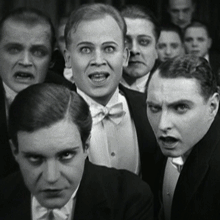
Finally, here's a photo of some typical 1920s Parisian concert-goers reacting critically to Poulenc's music...
 "Imbecile!! Vous devriez mieux continuer le style de Beethoven, alors!"

Sunday, 10 May 2009

Reconciliation: music dedicated to peace in the Middle East


Israelis spray burning phosphorus onto civilians in Gaza, 2009.
Can we even begin to imagine the horror?
mm
This music is dedicated to peace in the Middle East. Two clashing keys are eventually reconciled and, in the process, are fused together and completely transformed. These musical transformations are a metaphor for the huge social changes and compromises which will certainly be necessary for any political or social reconciliation.
mm
Reconciliation 
for string chamber orchestra or string sextet
(v, v, v, vla, vc, db; 6 min 03sec) 


Connect your device to a decent sound system or enclosed headphones, and click the orange PLAY button...


Alternatively, you could listen to the music at its URL:
http://soundcloud.com/peter-gore-symes/reconciliation
mm
If you wish, you can read the score (in pdf format) here
This link will open in a new window so you can follow the score while listening. 
Both the score and mp3 recording are free and downloadable.
mm
NOTES:
(For a quick overview, read the red bits only)
mm
00min:00sec The slow Introduction is symbolic of thousands of years of co-existence between Palestinian and Israeli peoples. However, embedded in this atmospheric passage is a brooding, unsettled sense of yearning, hinting of unresolved issues.
Technical notes: Introduction, bars 1- 15. The brooding unsettled mood at the opening is generated by a D-augmented triad (D, F#, A#) over a D pedal (the music is at least 'D-centric' if not in pure D-major), extended over unexpectedly long stretches of time (bars 1-3 and 8-10). At the start, the listener might normally have expected the key of D-major, but here the chord is disturbingly "corrupted" by the A# (notated here, for convenience, as Bb). An augmented triad is normally quite unstable and tends to resolve promptly to another chord, like iron filings drawn inexorably to a magnet. Here, however, at the very opening, its agony is prolonged for 3 full beats before momentarily changing to an A minor triad on the fourth beat. Bar 2 resumes the augmented triad, relentlessly sustaining the tension well into bar 3. This effectively turns conventional musical syntax on its head, making stable the chord which is usually unstable. By corollary, the normally stable A minor chord is treated as if it were a unstable passing dissonance. This inherent instability of augmented triads saturates a great deal of the Introduction: by way of example, see the bass (bars 6-7) and the viola (bar 7). In addition, the melodic outline of the future main theme is previewed in bars 1-3 and 8-10. Here the first violin meanders around the descending cells of F# E D (suggestive of D-major) and C Bb A (suggestive of F-major). This theme will feature in the next section "Robusto".
mm
00min:27sec A brief 'roll of thunder', swelling in the remote key of F-major (bars 6 and 13), followed by few brief moments of disturbingly jagged, lightning-like melody in the viola (bar 7) represent occasional social discord. You are at liberty here, Dear Listener, to visualize whichever Qu'ranic/Torahnic events you will. This Introduction, musically speaking, is a chilling premonition, a compressed exposé, of the two conflicting keys which are to become, in musical metaphor, the antagonists in the Muddle East.
Technical notes: The long-anticipated D-major triad does finally appear - but only momentarily - by the middle of bar 5, before being swept aside by the surging crescendo in F-major (bar 6). These two key centres are to represent Israel and Palestine. Sharing only the common note of A (first violin, bars 5-6), they exert a colourful chromatic-mediant relationship to each other. It is this relationship which is exploited (twice for emphasis) in the Introduction. It is perhaps fitting that the letter A should represent the common element between Israel and Palestine if you consider that the words "Allah" and "Adonai" both begin with "A": the two countries do worship the same God, after all.
mm
01min:32sec "Robusto" - the main theme begins.
 This innocent 6-note falling melodic motif contains all the musical seeds of the coming cataclysmic descent into conflict in the Middle East. Its melody can musically accommodate TWO keys (D-major and F-major, representing Israel and Palestine). All continues reasonably harmoniously, but at...
Technical notes: "Robusto": (bar 15, Rehearsal A)
The main theme (F#, E, D, C, Bb, A), as in the Introduction, juxtaposes the two keys D-major and F-major, thrusting them together even within the opening bar. The notes F#, E, and D constitute a segment of the D-major scale, and the notes C, Bb, and A suggest the scale of F-major. There are some repetitions of the theme, with embellishments, which serve strategically to to impress it on the listener's memory, given that it will re-appear, transformed, throughout the rest of the piece. The underlying harmony in each bar is a repeated alternation of two beats on D followed by two beats on F, ie, constant juxtaposition of the antagonist keys not unlike an ostinato.
mm
02min:08sec. ...things begin slowly to unravel and get slightly disjointed... until an unexpected dramatic pause…
Technical notes: After bar 20, however, the two keys begin to blur and overlap as the Fnaturals in the lower voices begin colliding violently with the Fsharps, as if someone were deliberately smudging the entire score. Appropriately, there are instances of "false relations", which, according to the conventional canon of music "laws", are the equivalent of an atrocity. In addition to this, the phrases become rhythmically more disjointed, harmonically more blurred and confused. These harmonic and rhythmic distortions and collisions symbolize the ongoing Palesine-Israel conflict.
mm
02min:22sec After the pause comes a brief allusion to "Tristan und Isolde" by Richard Wagner, the notorious 19th century anti-Zionist. Passions immediately inflame, with volleys of dissonant chords rising like tracer fire, and the two clashing keys of D and F angrily lock horns.
Technical notes: "Langsam" (Rehearsal B, end of bar 22).
At Figure B, the fragment of the Tristan theme (laced with even more chromaticism than the original) surges up to a spicy clash between F and F# at bar 25. Volleys of augmented chords rise like tracer fire during bars 25 and 26, cadencing on further F-F# explosions at the beginnings of bars 27 and 28. Just like the Middle-East conflict, there is no consistent logic to the sequencing of these chords. Prominent are F-augmented and F#-augmented, followed by some which spiral through the circle of fifths towards a chord of D-major/minor at bar 27. The chord at the start of bar 28 has lost any immediately recognisable tonal basis - it comprises mainly the notes of F and F#, the conflictual nub of the matter.
mm
03min:05sec Next, coming out of the blue like the proverbial white-hatted "posse" in a B-grade Western movie, a fragment of the melody "The Star-Spangled Banana" boldly steps into the musical fray. This rising ditty, of course, alludes to a familiar 20th century fundamentalist hamburger-consuming pro-Zionist superpower. Ironically, this intrusion seems to whip up even more angst than ever before. Under this needling provocation, the Middle East conflict quickly escalates into a searing musical conflagration in the high register of the violins. There is a series of violent flashpoints at which you might interpret screams of agony during Israel’s Six-day War in 1967, and Palestinian citizens deliberately crushed to death by Israeli bulldozers in the Jenin refugee camp, not to mention the calculated slaughter of more than 1300 Gazans in 2009.

Technical notes: "The Star-Spangled Banner" (Rehearsal C, bar 29)
The rising triad of "The Star-Spangled Banner" is doubled by basses and celli in octaves in imitation of brass-band voicings. (Incidentally, the word "Langsam" was Herr Wagner's choice, not mine). The level of dissonance between the instruments' parts increases after this (bars 29, 30), and their degree of musical rationality and accountability decreases. Fully-fledged war breaks out at bar 31 ("Appassionato molto") with head-on confrontation between Fsharps and Fnaturals.
...but Peace Talks continue, and small compromises slowly begin to happen. The source of cultural clash (represented in this music by the note F) is gradually eliminated, resulting in a building sense of relief and relaxation. The instruments begin to cascade slowly downwards, concluding in a curiously satisfying and peaceful cadence... 

Technical notes: The Fsharps (from bar 33; ironically a prominent note at the opening of Wagner's Tristan theme) begin to subdue and eliminate the Fnaturals during an extended descending passage. A tentative cadence at bar 37 arrives at Skryabin’s so-called Mystic Chord, which, both by being placed as the lowest pitch and by its louder dynamic, arbitrarily asserts the centricity of the note C over both D and F. Like tonal chords, this chord, with its strong quartal elements, is capable of being inverted to create subtle shades of harmonic colour.
mm
03min:56sec (Rehearsal C, bar 37) But now, lo and behold! This is an utterly new species of chord, the long-awaited moment of reconciliation between the two competing keys - they have been fused into a new entity altogether. In fact, from this point on, nothing in the music (or the Middle East, for that matter) can ever be the same as before. This unfamiliar New Chord is neither D-major nor F-major, but a negotiated composite of the two. It is a complete transformation of Tradition, both in music and social metaphor. The creation of this New Chord constitutes the pivotal moment in this entire piece. (Perhaps at this point I ought to coin the term "Peace Acchord"). This time, however, it is built on the foundation note of C, not D or F as before.
The sound quality of this New Chord may not be fully to the taste of either Palestine or Israel, but nevertheless it is the essential compromise with which they must learn to live. Could this mysterious New Chord metaphorically represent some Cosmic Compromise-maker, a canny Concord-broker? United Nations delegates sitting at The Round Table in the glassy "Tower of Babble" in New Camelot, perhaps? Can the peace last? Well, as the proverb goes, a Camel is a Horse designed by a Committee...

mm
04min:10sec "Ballo Dolente" = "Sad Dance" (Rehearsal D, bar 39). Now that peace is achieved, there is a dance of celebration - but it is a lugubrious and tired dance, soured by traumatic bloodied memories. Musically, the dance showcases the ethereal, strangely beautiful qualities of the New Chord, the ‘bringer of peace", in a number of varieties not unlike typical chord changes in a slow Blues. (I visualize these as akin to the ever-mutating qualities of dappled late-afternoon sunlight filtering through forest foliage). Their orderly movement is determined by traditional cadence formulae dictated from the deep by the domineering double basses, like a Council of Wise Elders, a metaphor for the authority of Musical Tradition.

Technical notes: Isolated from the other instruments, the bass-line during ‘Ballo Dolente’ would make perfect tonal sense to musicians from Mozart to Zappa to Leadbelly. Soaring over this rock-solid conventional bass-line are various transpositions of the Mystic Chord, conjuring up a kaleidoscopic palette of subtly different harmonic colours (given that there are always six of the possible twelve tones being heard at any one moment). This harmonic 'disconnect' between upper and lower parts makes for disturbingly disoriented experience for the listener* - a neat metaphor, perhaps, for the eternally polarized misunderstandings between governments and citizens.
 *To further illuminate the point about a tonal bass-line controlling a quartal environment, have a look /listen to my piece Chord Soup, a miniature I wrote as a pre-study to Reconciliation. Its time-scale is so compressed (less than a minute) that it may assist you to hear what I'm bonging on about here. Its structure is a simple I-V-I arch, so send your ears down to the double-bass).
 mm
05min:00sec CONCLUSION
As the dance draws to a close, worrying snatches from the Introduction are heard again, reminding us that it is all too easy to slip back into old ingrained thought habits and prejudices, or to permit extremist elements to re-ignite hatreds of the past. From this point on, however, the Musical East lives happily ever after, beginning with a series of three cadences at...
mm
05min:11sec ...in which the authority of the new musico-social language is re-affirmed, allowing the music to fade comfortingly into the future. In an effort to be democratically inclusive, the note F is offered a place. Although on first impression the texture of this final chord sounds vaguely similar to the very opening chord of the piece, it is actually quite different, utterly transformed by the reconciliation process. Thus the piece does NOT end as it begins: instead of the schematic paradigm 'ABA' so beloved of the 19th century European Enlightenment, this music adopts a more dynamic and forward-looking 'ABC' format.
Technical notes: There are unnerving flashbacks to 'augmented fifth' chords - like those heard back at the very opening. This constitutes a worrying re-emergence of the old musical language, a recidivist step in terms of the reconciliation process. There is even an ever-so-brief allusion to the rising minor 6th motif of Wagner's theme again, as well as the ‘thunder in F major’ (bar 50).


General note on the form of Reconciliation

The formal strategy underlying Reconciliation is not entirely alien to the musical reconciliation at the heart of the musical architecture of 18th-century Sonata Form. However, whereas the old Sonata Form required one key to completely vanquish the other to impose a "winner", my music simply merges both keys into democratic compromise and equality of status. I have attempted to broker a reconciliation between the sound-worlds of Tertian and Quartal harmony: in fact you may have noticed that the note of F, earlier so vilified and exiled during the musical ‘Peace Process”, has been quietly re-incorporated in the final cadences (from bar 47). Arbitrary exclusion of any note, any voice, would have represented a cultural loss to the entire community ...we all need to move beyond adherence to destructive social hierarchies, illogical land borders unrelated to cultural borders, or self-centered nationalisms. And historically, it is often the Artist who has volunteered to be the sensitive barometer, the mine canary, of social justice and change.
mm
The genesis of the music
At the musical heart of the portrait - and the very genesis of the the music - is the exquisite agony of the augmented triad. When I was very young I heard Schuman's sublime piano piece Traumeri, and was totally overwhelmed by its emotions: back then I had no idea, of course, that it was Schuman's sublime use of compositional devices such as augmented triads, double-diminished sevenths, dominant sevents with flatted ninths etc, that was the musical cause of the uncontrollable lump in my young throat.
mm
Years later, as a music student, it all became clear and "explainable" of course, even if in coldly rational prosaic terms. I duly absorbed the "Rules", handed to me on (well-tempered) Musical Tablets directly from Moses and Bach, such as "Thou Shalt Resolve Augmented Triads"... (and even more specifically, how they should be resolved!) Academe has such a lot to answer for in such Attempted Codification of the Uncodifiable - the Muses should be outraged at the insensitive "one-size-fits-all" authoritarianism. But all the same, I consciously determined never to lose those tingling sensations of musical magic I had felt as an untutored but attentive Young Listener.
mm
Now in later life, I have tried to re-conjure that, to weave all of the old magic deep into the fabric of Reconciliation and hopefully to carry it a step further, to intensify it, gently prod and challenge. Why must an augmented triad resolve into some other chord if you enjoy the sound of it 'per se'? For an even more thorough answer, I'm going off now into the Hereafter to consult with my friend Claude Debussy...
mm

Afterthoughts...
 I would like to have this music performed at any formal or informal send-off of my mortal coil, pre- or post-cremation ...preferably on something of better quality than a boom-box, with any luck. Reconciliation can be understood not only as a parable of the Middle-East, but also as a personal metaphor for my life. In fact, the piece began its existence as an autobiographical endeavour tracing the long road of recovery from sexual abuse. Later, I switched to the Middle-East dedication because I felt so strongly about the heartless bombardment of Gaza. So it is perhaps appropriate that an autobiographical musical portrait should accompany my Exit: the shape of the music reflects phases and transformations during my life, and those who are close to me may be able to understand what I mean when I say "personal metamorphosis".

Please ask those present to resist the senseless ritual urge to clap (clapping is such a noisy shattering atrocity after the otherworldly experience of focusing attentively to Music). Instead, simply allow a period of silent reflection before fading the lights back up. Fade the lights in the room, then allow some silence to elapse before beginning to play the music. Ditto, permit some silence after the music fades. Silences can be the element of a performance which have the capacity to speak the loudest. Please don't clap.

Tuesday, 5 May 2009

Chord Soup: a study in quartal harmony based on Skriabin's "Mystic Chord"

Chord Soup is a miniature piece for string sextet or string chamber orchestra (v,v,v,vla,vc,db). It was only ever planned as a short pre-study to my larger piece, Reconciliation. I had therefore never envisaged Chord Soup for public consumption, but had always harboured a secret soft-spot for it. Many months later, I went back and stirred it up a little... 

 Connect your device to a decent sound system or enclosed headphones, and click the orange PLAY button...
mm


Alternatively, you could listen to the music at its URL:
http://soundcloud.com/peter-gore-symes/chord-soup
mm
If you wish, you can read the score (as a pdf file) here.
This link will open in a new window so you can follow the score while listening.  Both the score and the mp3 recording are free and downloadable.
mm
Back when I first sketched Chord Soup, I was experimenting with its key ingredient, Skriabin’s ‘Mystic Chord’, excitedly tasting its characteristic flavours:
Read more about this chord at wikipedia.
mm
This chord is ‘non-functional’ in a conventional harmonic sense because it is Quartal, ie., it uses chords stacked in fourths instead of thirds. It is not unlike a mini-"skyscraper" chord, a thick, opaque chunk of sound. Presented in this manner, like a pinned insect specimen under glass, it looks (and sounds) like an inert and immovable object. After all, it uses up a full six of the twelve possible notes, whereas a "normal" chord requires only 3 or 4, or possibly 5 when 'extended' (eg, G, G7, or G9).
mm
Crucially, the Mystic Chord lacks a perfect fifth above its root (in this case there is no D above the G). This denies the chord a clear tonal axis, thus is a big factor in the ambiguity I so enjoy. But it is a moot point as to whether there is an identifiable "root" note at all ...ah, but I digress.
mm
Just like traditional tertian chords, the Mystic Chord (a.k.a. the "Prometheus Chord") can be arrayed in various dispositions, plus be inverted as well. Given that there are 6 notes available instead of the usual 3 or 4, simple arithmetic suggests that the number of possible voicings and inversions offers the composer a considerably larger number of options and (therefore) a much wider spectrum of harmonic colours and degrees of tension.
Herewith a few examples, from which one can extrapolate:
The quartal harmony born of Skryabin's chord therefore admits not only of fourths but a wide variety of intervals - even (gasp!) thirds and fifths. However, it lends itself most readily to a harmonic language favouring seconds, fourths, sevenths and ninths, thereby casting doubt on the assumed distinction between 'consonance' and 'dissonance' so smugly (and arbitrarily) asserted by conventional chord structures like C, G7, f#m, etc.
mm
Like tertian chords, Skryiabin's Mystic Chord can also be transposed through all 11 of the other semitones, eg., here I've transposed up it by a perfect fifth:
Given the assumption that "bass notes = root notes", Chord Soup can be reduced (in terms of Shenkerian Analysis) to the very simplest chord progression I - V - I, the simplest of tonic prolongations, plus a short formulaic coda (complete with traditional octave leaps circling in on the tonic at the end of bar 13):
This is, in effect, forcing Quartal Harmony (innately non-functional materials) into the straightjacket of functional traditional tonal conventions. It's rather like trying to mix oil into water: well, as they say, Impossible is Nothing. However, the ear can quickly reconcile the conflict precisely because the formal context is so familiar and unambiguous. It is also on an extremely compressed time-scale (only 15 bars or 56" long), thereby demanding precious little of the listener's musical memory. In short, the dilemma exists primarily on paper and in the Theorist's mind, not so much in the ear of the Listener.
mm
In fact, even the unsuspecting listener soon hears and accepts the quartal chord on G functioning in the role of Tonic, and the quartal chord on D functioning as in the role of Dominant. The usual principles of perceived consonance and dissonance apply just as much here as they do in Mozart or Mahler - the quartal chord on D is heard as "the dominant" precisely because it has been placed in a position conventionally heard as relatively unstable. It's the "B" in the old "ABA" paradigm.
The "arch form" of the first violin's melody also facilitates this perception of Tonic-Dominant polarity. The violin melody surges up in waves to the high point at bar 5, and so does the bass, at which time the harmony changes to chord V. From that point it reverses direction and begins falling in similar waves until the return to chord I at bar 9. Likewise, the bass rises and falls to assist the ear to articulate these pivotal structural moments. The violin and the bass are therefore not just pretty faces, but actively serve to highlight the harmonic architecture of the entire piece.
mm
And just like all "normal" tonal I - V progressions from Machaut to Madonna, there is even a "common note". In fact, the composer exploiting the intriguing resources of Skryabine's Mystic Chord happily discovers the luxury of a choice between two common notes (in this piece, the notes E and B). Listen, for instance, to the note E in the first violin during bars 4 and 5 as the harmony underneath changes from I to V.

Sunday, 3 May 2009

There Came A Glance From Igor
(Woodwind Trio)


I wrote There Came A Glance From Igor (wind trio: flute, oboe, bassoon) mainly as a tribute to Stravinsky, who helped me (along with Charles Ives and Sebastian Bach) to stretch my youthful ears.
mm
Connect your device to a decent sound system or enclosed headphones, and click the orange PLAY button...


mm
Alternatively, you could listen to the music at its URL:

http://soundcloud.com/peter-gore-symes/there-came-a-glance-from-igor
mm
If you wish, you can read the score (as a pdf file) here. This link will open in a new window so you can scroll thru the score as the music plays. Both the score and the mp3 recording are free and downloadable.
mm

Ralph Vaughn-Williams provided the wonderful melody ("Linden Lea") which forms the backbone of the Trio, but it is to Stravinsky that I owe most debt. Like Stravinsky, I enjoy woodwinds: their individual "enameled" timbres ensure linear clarity in a self- consciously polyphonic texture, and therefore militate against the sometimes cloyingly sentimental harmonic blend of strings so tiresomely favoured by 19th century Romantics. Stravinsky ("Counterpoint is my natural home") also loved the music of Bach: his Dumbarton Oaks Concerto was a clear neo-Baroque tribute to the Brandenburg Concerti. My trio (a set of variations with finale) therefore opens in a distinctly Bachian "common practice" contrapuntal style. The attentive listener, however, will soon notice occasional and increasing intrusions of quartal and secondal sonorities. It is these which constitute the "glances from Igor" implied by the title.
mm
Harmonies such as these (built on fourths, seconds, sevenths and ninths) do not automatically suggest the same tonal functions as traditional tertian (triadic) harmony, so can sound more "static". Blending and reconciling these two musical languages was the underlying aim of my piece. Vaughn-Williams' melody, employed as a "wandering" Cantus Firmus, imparts familiar musical architecture, comforting cadence formulae, and clearly implied syntax offered by its regular phrase structure. These aspects are the music's "bones", which are then fleshed out by the spectrum of quartal harmonies. As the music progresses, the subtle shadings of quartal colours begin to reconcile with conventional elements.
mm
The finale departs from the safety of the melody line by using only its opening motif in a quasi-fugal texture: thank you Herr Bach. But the finale is tri-tonal: thank you Mr Ives. And thank you, Dear Reader, for taking the time to read me blog.

Thursday, 9 April 2009

FOUR BRITISH FOLKSONG SETTINGS (for SATB)

 
 Although these are 'stand-alone' songs, all four of them are on the following recording. Together, they make up about a 10-minute concert item, but performers may choose fewer, or re-order the sequence. The songs, in the recorded order, are
    1. The Oak and the Ash
    2. Rosebud in June 
    3. Bonny at Morn

    4. Searching for Lambs

Connect your device to a decent sound system or enclosed headphones, and click the orange PLAY button:


Alternatively, you could listen to the music at its URL:
http://soundcloud.com/peter-gore-symes/four-british-folksongs
mm
If you wish you can follow all the scores here in a new window as the music plays.
The score and the mp3 recording are free and downloadable. Ensembles are free to perform this music with no risk of copyright infringement - just acknowledge me in announcements or program notes as the composer. The music was composed in 2009 and revised in 2011.
mm
These computer-synthesized mp3 recordings are by no means intended as the "authorized version" in terms of performance. They are intended merely as a private introduction for each performer prior to the start of rehearsals, therefore should never be broadcast. Indeed, I necessarily had to compromise artistically between the need for rigid adherence to the beat and the more interpretative and delightfully flexible reality of flesh-and-blood performers.
mm
The lyrics are traditional. Computer music notation programs such as Sibelius (as far as I am aware) cannot yet actually pronounce words, thereby denying these songs their pivotal aspect, that of "Story-telling". The computerized “vocalize” quality on the recordings is necessarily a bland compromise when compared with real voices singing real words. I also encourage performers to approach these arrangements with a flexible and relaxed attitude to phrasing, much like folk-singers do - it is appropriate with this music that enjoyment, passion, and a cheeky sense of humour overcome the stultifying strictures of "correct" academic musical protocol.
mm
It may feel intuitive, for instance, to accelerate a little during a rising passage where the lyrics are leading towards some crucial word. A well-placed silence can be magic, akin to a painter’s dramatic use of white. Experiment with holding pauses just that dangerous bit longer than written, and watch what happens. Take time to breathe between phrases. Also, where lyrics suggest social/comic interaction between characters, don't feel inhibited to enliven and entertain by indulging in occasional "wink-wink, nudge-nudge" stage histrionics. It is true, though, that understatement is both more humorous and dignified. And so much more, yes, "British", old chum.
mm
Performers will need a proficient intervallic sense for well-intoned performance of the harmony. Although the melody is always clearly present in one voice or another, the surrounding voices clothe it in a constantly mutating blend of Tertian, Quartal/Secundal sonorities. Resist the temptation to employ a rehearsal pianist - purer intonation as the result of listening to each other will generate a sonority sweeter than the piano’s equal temperament. Ironically, these recorded versions, even though nominally ‘vocal’ sounds, are actually equally-tempered due to the setup of the Sibelius program. In that sense, live singers have the opportunity to adjust sizes of intervals and thus produce a version harmonically even ‘sweeter’ than the recordings. To this end, I suggest some rehearsal run-thrus at molto adagissimo. Take care to minimise if not entirely eliminate vibrato... in the interests of accurately honed  temperament.
mm
Real folksingers often delight in ad-lib embellishment of a melody. I have written out some such ornaments, but encourage whichever singer has the melody from moment to moment to enjoy venturing into a few (tasteful) ones of their own. If you have fun, the audience will too.
m

Wednesday, 19 March 2008

Peter Gore-Symes: "Classical" music, the Universe, and Everything


I've spent a good deal of my life spending energy on other people's music - teaching about it, compereing it, broadcasting it, performing it, being a crit... so now that I have more leisure time in retirement at Chiangmai (in the north of Thailand), it's gonna be more about my own works. So there. 
UPDATE: As of May 2014 I'm now back in Straya.
spacer
Notes About Music is a space where I doodle in a shamelessly self-indulgent way about the nature of my recent "Classical" Music Compositions, the Universe and Kitchen Sinks... but mainly about my music. 
spacer
If you like the look of one of my pieces, and would like for courtesy's sake to ask me for performance rights, contact me at goresymes@gmail.com. Obviously, both the recordings and the scores are technically copyright, but I'd in all likelihood I'd be happy to approve performance of either provided the normal notification protocols and courtesies are observed and acknowledgement made on announcements, printed programs etc. I do not seek to become the wealthiest de-composer in the graveyard. I am rich enough already because I have a good life, a good wife, and Lovely Free Time (yee-HAH! at last!) to indulge in creative pursuits.
spacer
So - what music do I write? For starters, it's not "Classical", as MySpace once rigidly tried to label me. Did I have a choice? Maybe Ska-Punk or Death Metal could have been better alternatives if indeed I sought to solicit more hits. Nope, Classical means Telemann, Haydn, CPE Bach, Mozart. My stuff's not "Classical". Period. For a start, it is composed and synthesized on a computer. Here's a poke in the eye with a quill, Herr Ludwig. But it is an inevitable cultural reference point for everyone, and anything new is always heard against Classical music as a 'departure'.
spacer
What else isn't it? It isn't Baroque, Romantic, Rococo, Renaissance, Mediaeval or 20th-century either, yet it eclectically draws a great deal from all of these periods. My music has all been composed in the 21st century, so I suppose that has to be its "label". But labels are dangerously slippery. We are all fragile snowflakes and tough individuals. Maybe I'm the Charles Ives of Thailand ;-) The concept of distinct musico-historical 'periods' is, I feel, a necessary fiction to make generalisations about the chaos and stylistic variability that was the reality of History. It's all about the need to artificially systematize historiography, reduce it to distinct dumb-down chapters, and thus make it 'packaged and teachable' in schools and conservatories. I prefer a more longitudinal approach which is free to recognize the potential symbiosis between Jazz and 13th century Motets, Raga and Gregorian Chant... and sometimes finding new environments and tasks for old instruments...
spacer
Each piece can be heard via a link to the SoundCloud website, accessible via the orange 'PLAY' button. There you'll find free downloadable mp3s of my music which I cobbled together using Sibelius software.  Pleeeease be sure to use quality earphones pressed in close to your ear to capture enough bass, because computer speakers are usually hopelessly tinny. Scores are available in pdf format as per the links offered to Scribid.com  and they are downloadable and free too.  You can see them all together here at scribd (the link opens in a new window).


Here's my take on the classic “I-don’t-know-anything-about-music-but-I-like-it” Syndrome...
I get this all the time. On hearing that I compose music, people often look slightly uneasy and hasten to comment “I don’t know anything about music, but I do enjoy it”.  Upon hearing some of my compositions, these people tend to comment “That’s interesting” (Read: I don’t like it much... bit weird for me”).

I don’t mind in the least.  It’s just fine. I think I have some insight into the dynamics at play here, so I'll claim right now that everyone (repeat: everyone) within western culture “understands” music.  Perhaps not the printed version or formal music theory, but I insist that people’s ears intuit much more than they give themselves credit for. Much more.

From the day we’re born – and some would argue from before birth – we are relentlessly bombarded with musics.  Many types. Wander through any shopping mall or dental surgery to confirm this. As we grow through our toddler years our ears are saturated in music every day. We become so desensitized that sometimes we no longer even focus on the fact that music is there.

In this environment, it should come as no surprise that some of it sticks, despite our lazy inattention. In fact, a large amount sticks. Just as children accumulate a largely untutored understanding of the conventions of spoken language, we all similarly absorb the conventions of musical language. We can’t help it. The human brain works that way, seeking as it does to find order and consistency in the world around us.

Music is indeed a form of language, defined as a system of sounds which have their own meanings and interactions. Music has its own complex grammar and syntax which conceptually parallel those of spoken language.  Musical nouns, verbs, sentences.  If it didn’t have these things, music theory courses couldn’t exist. Those of us who became musicians all diligently learned the ‘rules’ of music (handed down on Stone Tablets from Bach) during endless tutorial exercises.

And, paralleling spoken language, music has similarly developed its own written notation.   Interestingly, we are all carefully taught how to write words and to spell them correctly – indeed it is a priority in schools – but precious little importance is attached to how to write music or spell chords and scales. It's no wonder people can't do it - and therefore develop a morbid fear of it.

Despite this, toddlers from an early age unconsciously detect this grammar and syntax which make up the fabric of most conventional music. However, just like spoken language, musical language is inconsistent and subject to variation in dialect. So the commonly used term ‘the rules of music’ might be better replaced by ‘the norms of music’.

Very young children can be observed to respond to the simpler elements of beat and rhythm in the same way that their first spoken words are likely to be concrete nouns... mama, puppy, car. They can be seen to attempt to clap in time to a beat even if their motor skills don’t yet permit accuracy. But behind the scenes, the child’s amazing brain is busy sucking up wordless information about other elements of music as well. Chords, harmonic structure, scales, counterpoint, chromaticism, tonality. Yes, you too already have all these concepts stored between your ears, even if you have no idea at all what the words mean.

As with language acquisition, this certainly doesn’t happen in any organized or set sequential way. As the child acquires more and more experiences of music, she is increasingly able to distill what is statistically ‘normal’, even though unable to verbalize it. Each new piece of music heard is subconsciously compared to the child’s memory bank of musical experiences, and assessed as familiar or new – or somewhere in-between. A chord of C during a nursery rhyme is highly likely to be followed by a chord of F or G7... and children quickly learn to hear it as ‘normal’ (ie ‘good’). If that chord of C were to be followed by F#minor, the child’s ear might register slight alarm/discomfort to the extent that the chord sequence didn’t match any previous experiences (ie, 'bad').

Statistical predictability such as this certainly applies at an early age to simple elements like rhythm and beat. For example, most of our music is grouped in 2 or 4 beats, sometimes 3 or 6, but rarely 5 or 7.  However, children in Africa grow up accepting 5 beat patterns as entirely normal. Dave Brubeck’s piece ‘Take Five’ (1 2 3 4 5 1 2 3 4 5) is an example from our end of the planet, but it is a relatively rare beast. There is a mere handful of English folksongs in 5 beats, but the list virtually stops there.  Children grow into adults not ‘understanding’ (= not liking) such music simply because it doesn’t conform to their unconsciously acquired norms. If a child could verbalize her feelings, she might say: This song feels a bit strange... I don’t seem to be able to clap along to it like I can in other songs’.  However, it would come far more easily to an African child. And to me as a western composer it offers a wonderful and refreshingly asymmetric rhythmic option, in conscious contradiction of the norms I absorbed as a child.

Our informal musical 'education' can be regarded as lifelong indoctrination or passive brain-washing.  By constantly drip-feeding conventional music into our ears, the boundaries of what music ‘should’ be are slowly and effectively laid down in stone.  Musical tastes are established and solidified from a surprisingly tender age.  Proof?  Japanese children imbibe the subtleties of the bent notes of Japanese koto music. Indian children absorb ragas and microtones into their very essence. And all of us in the West can tell immediately when someone has played a ‘wrong note’ in their piano piece.* 

So, by adulthood, we have all developed a pretty keen sense of what is ‘normal’ in music, what is ‘right’ or ‘wrong’, appropriate or inappropriate, and therefore (by extension) what we evaluate as ‘good’ or ‘bad’.  Unsurprisingly – and unfortunately – radio programs of new music are mostly scheduled in late night time-slots, well away from prime time when innocent vulnerable children might get to benefit from them.

Most conventional music we hear has a high degree of predictability from moment to moment. Press the ‘stop’ button at any random point during a piece of music, and ask the average adult ‘non-musician’ to try to imagine what will happen next. Most times, after you play through the passage again, they will indicate “Yep, that’s pretty much what I thought might happen”.  They are invoking their subconsciously acquired understandings of the rules/norms of expectation. As Winston Churchill quipped: ‘Commonsense is the collection of prejudices acquired by age eighteen’.

So when a visitor trots out the usual ‘I-don’t-know-anything-about-music’ comment, I smile inside and assure them that the only real difference between them and me is the fact that I have learned the skill of writing down the sounds which both of us already understand.
This principle applies equally well to composers and musicians. Ned Rorem wrote:  Composition is notation of distortion of what composers think they've heard before [...] Masterpieces are marvellous misquotations. And Howard Dietz quipped: Composers shouldn't think too much - it interferes with their plagiarism.  These apparently frivolous comments in fact reflect the basis upon which a lot of my own music is predicated.  Yep, where there's smoke, there's fire. I like to inhabit that dangerous, murky and ambiguous zone between the Conventional and the Different, between the Expected and the Unexpected. 

When chewing my pencil and staring at a scarily blank page of music manuscript, my compositional starting point is the culturally-acquired musical expectations all my listeners have. Like all of us, I too have learned what is ‘normal’ in music. Then, like a cat plays with a mouse, I lull my unsuspecting listener into subconsciously predicting what might come next, then mischievously swerve sideways into something quite different. After all, why bother writing something if someone else has already written it?  Yadda yadda...
------------------------------------------------
 * Ultimately, it can be argued that there is no such thing as a ‘wrong note’ – it actually depends on intention and on what happens immediately following the ‘wrong’ note in order to 'resolve' it. Context is everything. As Alhaji Ibrahim Abdulai said, half-jokingly, Every mistake is a new style’.
-------------------------------------------------
So, be very careful when approaching my music. It's dangerous. It can suddenly turn on you when you least expect it :) In particular, I have a fondness for taking irreconcilable opposites and watching what happens when they're mixed together...